
Gutters, Sand and Rain: The Roof Failure That Has Nothing to Do With Your Roof
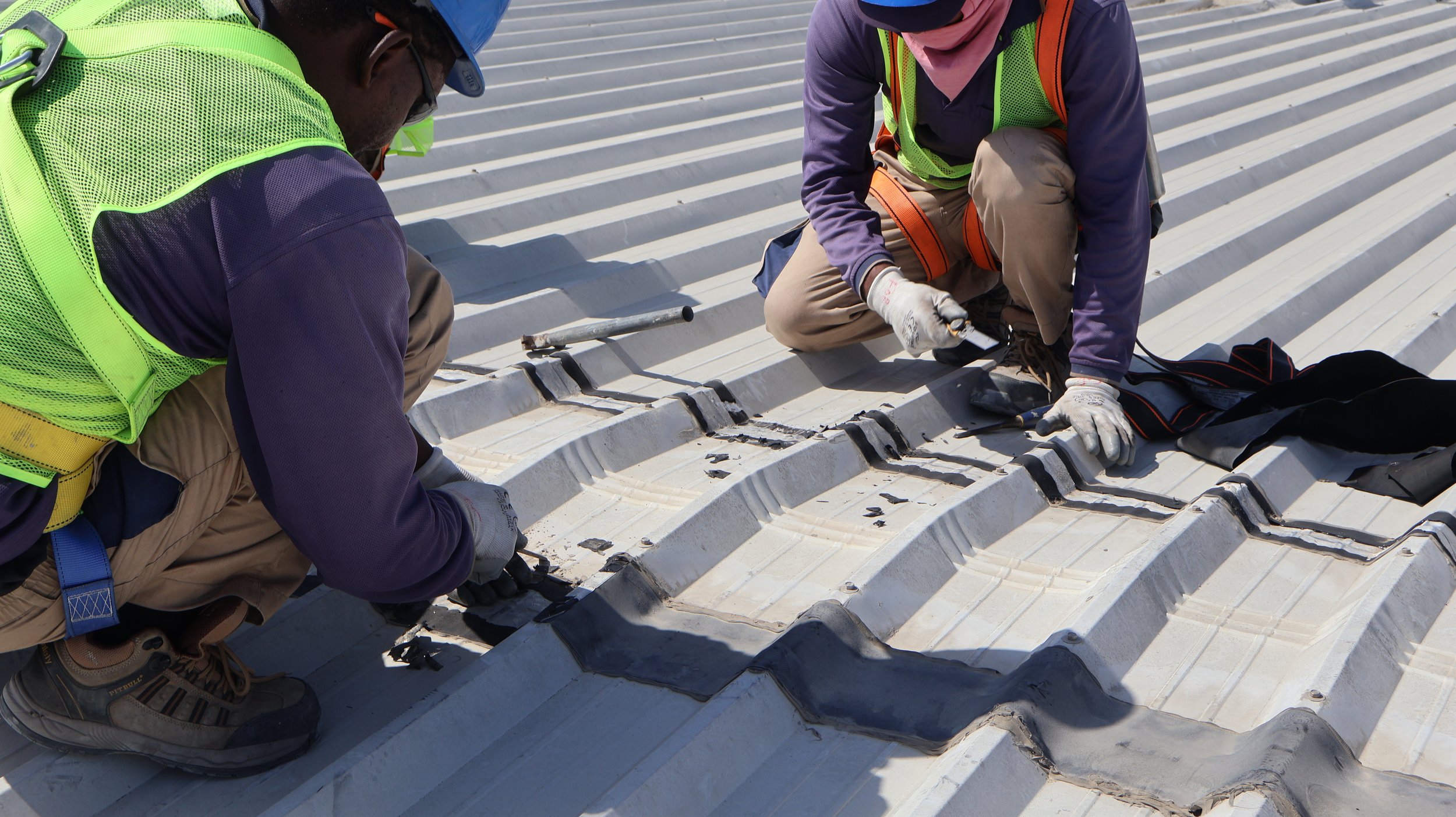
Some of the most expensive water damage we see in Dubai warehouses happens through roofs that are in good condition.
The building floods. Stock is damaged. Everyone looks at the roof sheets. The sheets are fine. The problem was three metres away, in a gutter that had been quietly filling with sand for four years and finally could not cope with a heavy rain event.
Drainage is a separate system from the roof, it fails for entirely different reasons, and in this region it deserves attention that it almost never gets. Here is why.
The mechanism
A gutter is sized to carry a certain volume of water per minute. When it cannot, water backs up and rises.
On a metal roof, the gutter sits below the ends of the roof sheets. There is a level at which rising water in that gutter reaches the underside of the sheet ends, and above that level it stops draining and starts flowing backwards into the building, under the sheets, along the purlins and down onto whatever is below.
The roof has not failed. Every seam and fastener may be perfectly sound. The building floods anyway, and it floods fast, because once the gutter is over capacity the entire roof area it serves is delivering water into the building rather than away from it.
Why this is a UAE-specific problem
Three factors compound here in a way they do not in most climates.
Sand accumulates continuously. Not seasonally, not after storms only. Dust and sand settle on roofs constantly and migrate to the lowest point, which is the gutter. Over a few years a gutter can hold a substantial bed of compacted material along its length, and every millimetre of that is capacity removed.
Rain arrives in short, intense bursts. Dubai's annual rainfall is low, which is precisely why drainage gets neglected. But that rainfall does not arrive gently over months. It arrives as a small number of heavy events, and drainage systems are tested by intensity rather than by annual totals. A gutter running at half capacity copes with light rain for years and fails completely in the one hour that matters.
Nobody looks. A gutter on a warehouse roof is invisible from the ground and from inside. Unlike a domestic gutter that overflows visibly down a wall, an industrial box gutter fails inward, and the first evidence is water on the floor.
There is a further wrinkle specific to this climate. A gutter holding damp compacted sand against steel for years is a corrosion cell. It is common to find the gutter itself has thinned or perforated under the debris, so that clearing it reveals a second problem underneath.
The warning signs
Most of these are visible without going onto the roof.
Water appearing along the building's edges during or shortly after rain, rather than in the middle of the floor. Edge-line water is a drainage signature.
Staining on the inside of the external walls near the eaves, or rust trails on the steelwork at the perimeter.
Downpipes that stay dry during rain while others run. That usually means the blockage is upstream, in the gutter, not at the outlet.
Plant growth in the gutter line, visible from the ground on some buildings. If something is growing up there, it is growing in accumulated organic material and sand, and it has been there a while.
Water that only appears during heavy rain, never during light rain. This is close to diagnostic. A roof leak leaks whenever it rains. A capacity problem only appears when volume exceeds what the system can carry.
That last point is worth holding onto, because it separates a drainage problem from a roof problem before anyone has climbed a ladder, and the two need completely different work.
What proper drainage maintenance covers
Clearing debris is the obvious part and the smallest part.
Full-length clearance. Removing accumulated sand, dust and organic material along the entire run, not just around the outlets where it is easiest to reach.
Outlet and downpipe check. Confirming each outlet actually flows. Blockages frequently sit in the downpipe below the visible outlet.
Condition inspection underneath. With the debris removed, inspecting the gutter itself for corrosion, thinning, perforation and failed joints. This is the step that gets skipped, and it is the one that finds the expensive problem early.
Joint and seam sealing. Gutter joints move and their sealant ages like any other. On a long run this is a common leak source independent of blockage.
Capacity assessment. Whether the system is adequate for the roof area it serves, which is a question worth asking on any building that has been extended, or where roof area has been added without the drainage being revisited.
Rate the risk. Not every gutter needs the same attention. Runs serving large roof areas, or discharging above sensitive equipment or high-value stock, justify more frequent checks than the rest.
Timing
Twice a year is the sensible baseline: once before the rain season, once after. The pre-season clearance is the one that prevents flooding. The post-season inspection is the one that catches damage while it is still small.
A check after any major storm is worth adding, since wind moves a great deal of material around a roof in a short time.
If your building has had rooftop work done, by anyone, for any reason, check the gutters afterwards. Off-cuts, packaging, fixings and general site debris end up in gutters with remarkable consistency, and a single dropped item can obstruct an outlet completely.
Where this sits in a roof project
Gutters and their outlets are one of the named critical areas treated in every TOPPS® waterproofing system we apply, alongside seams, sidelaps, fasteners, flashings, skylights and penetrations. On a restoration project the gutter line is cleared, inspected, repaired where necessary and sealed as part of the works.
But drainage is also worth attending to on its own, between roof projects, because it is inexpensive relative to what it prevents and because a sound roof does not protect a building with an inadequate drainage system.
Solaroofing has worked exclusively on metal roofs in the UAE since 1994, for clients including the UAE Ministry of Defence, Dubai Police, Dubai Civil Aviation Authority and Drydocks World, alongside factories and warehouses across Jebel Ali and Dubai's industrial areas.
Frequently Asked Questions
Can a blocked gutter flood a warehouse through a sound roof? Yes, and it is one of the more common causes of serious water damage in this region. When a gutter exceeds capacity, water rises above the level of the roof sheet ends and flows backwards into the building beneath the sheets. Every seam and fastener on the roof can be in perfect condition while this happens.
How often should industrial roof gutters be cleared in Dubai? Twice a year suits most buildings: once before the rain season and once after, plus a check following any major storm. Sand and dust accumulate continuously here rather than seasonally, so the interval is driven by dust exposure rather than by rainfall.
How do I know whether I have a roof leak or a drainage problem? The clearest indicator is the pattern. A roof leak appears whenever it rains, including light rain. A drainage capacity problem appears only during heavy rain, when volume exceeds what the system can carry, and the water typically shows along the building's edges rather than across the floor.
Why do gutters corrode faster than the rest of the roof in the UAE? Because accumulated sand and debris hold moisture against the steel for extended periods after rain, rather than allowing it to dry. It is common to find that clearing a long-neglected gutter reveals thinning or perforation underneath the debris.
Is gutter work included in a roof waterproofing project? Yes. Gutters and outlets are one of the critical areas treated in a properly specified waterproofing system, so the gutter line is cleared, inspected, repaired where needed and sealed as part of restoration works.
We had contractors on the roof recently. Should we check the gutters? It is worth doing. Off-cuts, packaging, fixings and general debris routinely end up in gutters during rooftop work of any kind, and a single item lodged in an outlet can obstruct it completely.
