
Roof Restoration or Roof Replacement: Which Does Your Building Actually Need?
At some point, you get told that your roof needs replacing.
It is usually said casually, by someone who has been up there for twenty minutes, and it lands as a capital expenditure item with six figures. The conversation that follows is about budget cycles and board approval, and it tends to skip the question that should come first: does this roof actually need replacing, or would restoration be a wiser option?
For most industrial roofs in the UAE, the real answer is restoration. Not always. But often enough that the question is worth asking properly before anyone starts costing a replacement.
What replacement actually involves
The sheets are the smallest part of it.
Replacing an industrial roof means removing the existing one, which means the building is open to the sky in sections for the duration. That drives everything else:
Operational shutdown. Stock has to be moved or sheeted. Production in the affected bay stops. On a food, pharmaceutical or electronics facility, an open roof is not only an inconvenience, it is a contamination control problem.
Weather exposure. Any roof opened during the rain season is a risk, and any roof opened during summer exposes the interior to heat gain the building was never designed to absorb.
Services disruption. Everything mounted on the roof comes off and goes back. AC units, extract fans, cable trays, solar arrays if you have them. Each one is a separate trade, a separate programme item and a separate opportunity for something to be refitted badly.
Structural discovery. Once the sheets are off, the purlins are visible. If they have corroded, and on an older roof some will have, the scope grows mid-project.
Programme length. Weeks of access, lifting equipment and site presence, rather than days.
Safety risks. Roof replacements require working at height in hazardous conditions. Even with proper safety measures in place, accidents during roof installations still happen, and they are more common than most people think.
None of that appears on the first estimate. It appears in the second and third month of the project.
What restoration involves
Restoration treats the roof you already have before declaring it the problem.
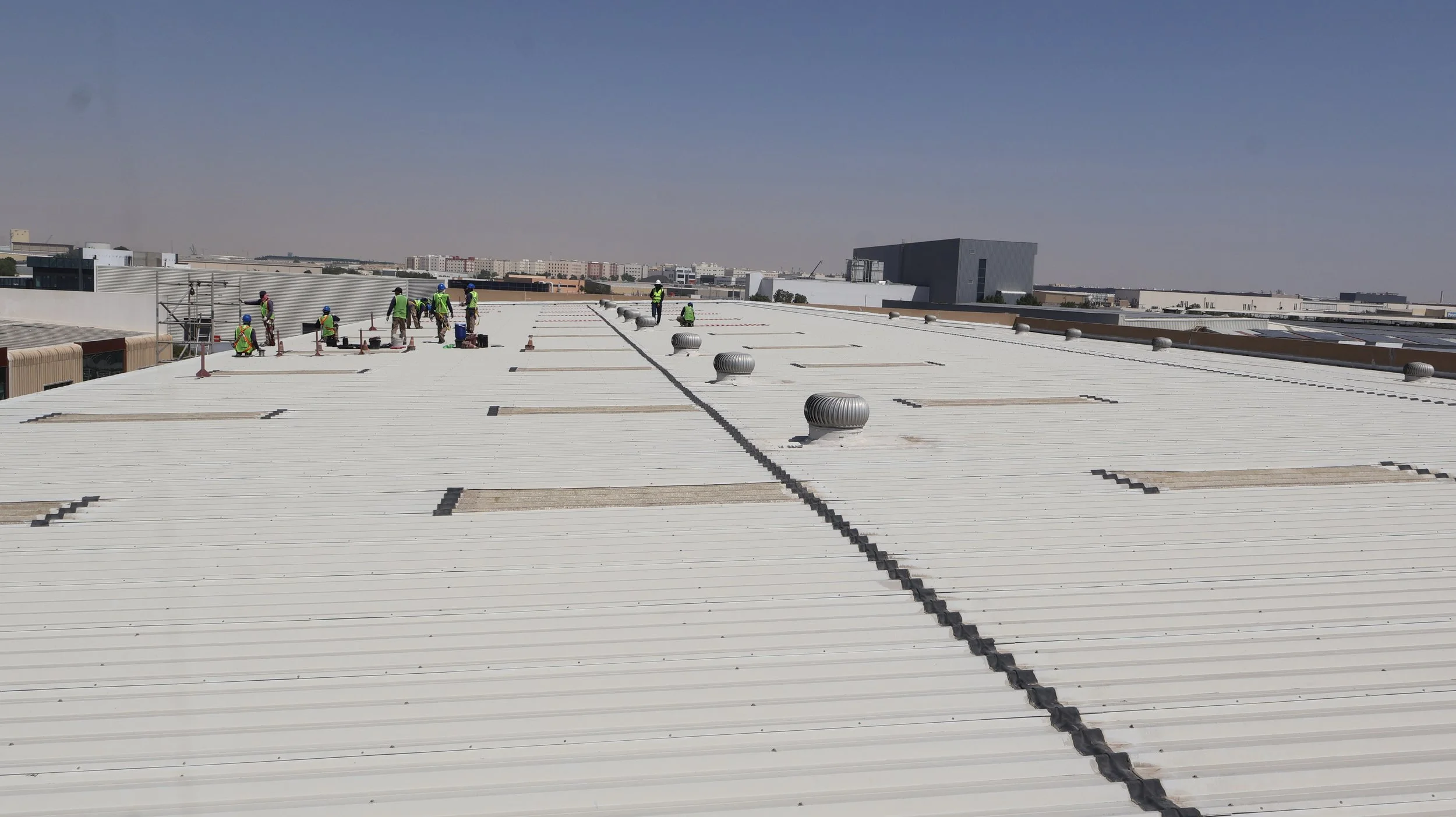
The sequence is: survey the full roof, remove failed sealants, deep clean the sheets, treat corroded areas, reinforce weakened sections with new metal sheets bent to match the existing profile, then seal every critical area and, where the system calls for it, coat the entire roof surface.
The building stays closed. All works happen from the roof exterior. Production, storage and loading continue underneath, with scheduling agreed around your shift patterns. Nothing comes off the roof and goes back on.
At the end you have a roof guaranteed watertight, with a warranty from five years for critical-area sealing up to 10+ years for full restoration with a reflective coating, always extendable. We have been maintaining some UAE roofs for over twenty-five years on that basis.
The economics
The useful comparison is not restoration cost against replacement cost. It is total cost of each route, including everything replacement drags behind it.
Against a replacement you have to count the sheets and labour, the removal and disposal of the old roof, the temporary weather protection, the removal and reinstatement of all roof-mounted services, any structural work discovered once the sheets are off, and the cost of whatever operational disruption the shutdown causes your business. That last item is frequently the largest number on the list and the one nobody puts in the comparison.
Against a restoration you have the survey, the preparation works, the materials and the application. This is much less intrusive, and often a cheaper overall option.
Restoration is a fraction of replacement for most roofs. The gap is wide enough that even when a restoration needs significant corrosion treatment and sheet reinforcement, it usually remains the economical route by a clear margin.
When replacement genuinely is the answer
It would be easy to argue restoration is always right. It is not, and pretending otherwise would eventually cost a client more than it saved them.
Replacement is the correct call when:
The structure has failed, not the surface. Purlins with significant section loss, or sheets corroded through across large areas rather than in localised patches. A coating protects sound metal. It does not restore metal that is no longer there.
The roof is being reconfigured anyway. If the building is being extended, the roof line is changing, or the facility is being repurposed in a way that changes the roof's loading or layout, restoration solves a problem that is about to be replaced regardless.
The specification no longer suits the use. A single-skin roof on a building that has become a cold store is an insulation problem, not a waterproofing one. Sealing it will not fix the condensation forming underneath.
It has genuinely reached the end of its life. Some roofs are simply too worn out or deteriorated to repair. A survey will say so.
In our experience, these cases are the minority. The majority of industrial roofs we are called to look at in Dubai have sound structure and a failed surface, which is exactly the condition restoration is designed for.
A new roof still requires waterproofing
Most often, the promise of a new roof makes owners quickly forget that it too needs waterproofing in order to remain watertight and extend its life.
Left as it is, in the UAE's atmospheric conditions, even a new roof will deteriorate and start leaking within a few years. The bottom line is that a proper roof waterproofing system is a necessity to keep any metal roof in our region watertight, whether new or old.
That changes the comparison. A replacement is not the end of the spending, it is the start of a new maintenance cycle on a roof that still needs protecting. A restoration delivers the waterproofing system as part of the same works.
How you find out which one you have
Not from the roof's age. A twenty-year-old roof that has been maintained can be in better condition than a five-year-old one that was never paid attention to.
You find out from a survey of the full roof: the condition of seams, sidelaps, fasteners, flashings, skylights, penetrations and gutters, the state of any existing coating, and crucially the extent and depth of corrosion. Surface rust and section loss look similar from a distance and mean completely different things.
Solaroofing has been waterproofing metal roofs in the UAE for over 30 years, for clients including the UAE Ministry of Defence, Dubai Police, Dubai Civil Aviation Authority and Drydocks World, alongside factories and warehouses across Jebel Ali, Dubai Investments Park, National Industries Park, Dubai Industrial City, Al Quoz Industrial Area, Musaffah, ICAD and numerous other industrial areas within the UAE.
If someone has told you your roof needs replacing, a second opinion costs nothing. Our surveys are free and the report is yours to keep either way, including if the honest answer turns out to be that they were right.
Frequently Asked Questions
Is roof restoration cheaper than roof replacement? For most industrial roofs, substantially. The gap widens once the full cost of replacement is counted: removal and disposal of the existing roof, temporary weather protection, taking off and reinstating all roof-mounted services, any structural work found once the sheets are removed, and the operational cost of the shutdown. Restoration avoids all of those because the building stays closed and all works are carried out from the roof exterior.
How do I know whether my roof can be restored? It depends on the condition of the metal rather than the age of the roof. Where the structure and sheets are sound and the failures are at seams, fasteners, flashings and coatings, restoration is appropriate. Where corrosion has caused section loss across large areas, or purlins have degraded, replacement becomes the honest recommendation. A full roof survey establishes which of the two you are dealing with.
Will we have to stop operations for a roof restoration? No. All works are carried out from the roof exterior, so production, storage and loading continue underneath. Scheduling is agreed in advance with your facilities team around your shift patterns. This is one of the main practical differences from replacement, which opens the building in sections.
How long does a roof restoration take compared with a replacement? Restoration is measured in days to weeks depending on roof area and the extent of preparation required. Replacement runs considerably longer because it involves stripping the existing roof, managing weather exposure while the building is open, and removing and reinstating every roof-mounted service. On top of that, a new roof would still require a proper waterproofing system and maintenance to remain watertight.
What happens to our solar panels if the roof is replaced? They come off and go back on, which is a significant cost and a risk to the array and to the roof penetrations. This is the main reason we recommend establishing the roof's condition before solar is installed rather than after. Once an array is in place, both restoration and replacement become more expensive and more disruptive.
My contractor says the roof needs replacing. Should I get a second opinion? It is worth doing, because the two routes differ enormously in cost and disruption and the decision is usually made on a short visual inspection. A full survey that documents corrosion depth, structural condition and the state of each roof element gives you the basis to make the call. Our surveys are free and the report is yours whether or not you appoint us.
