
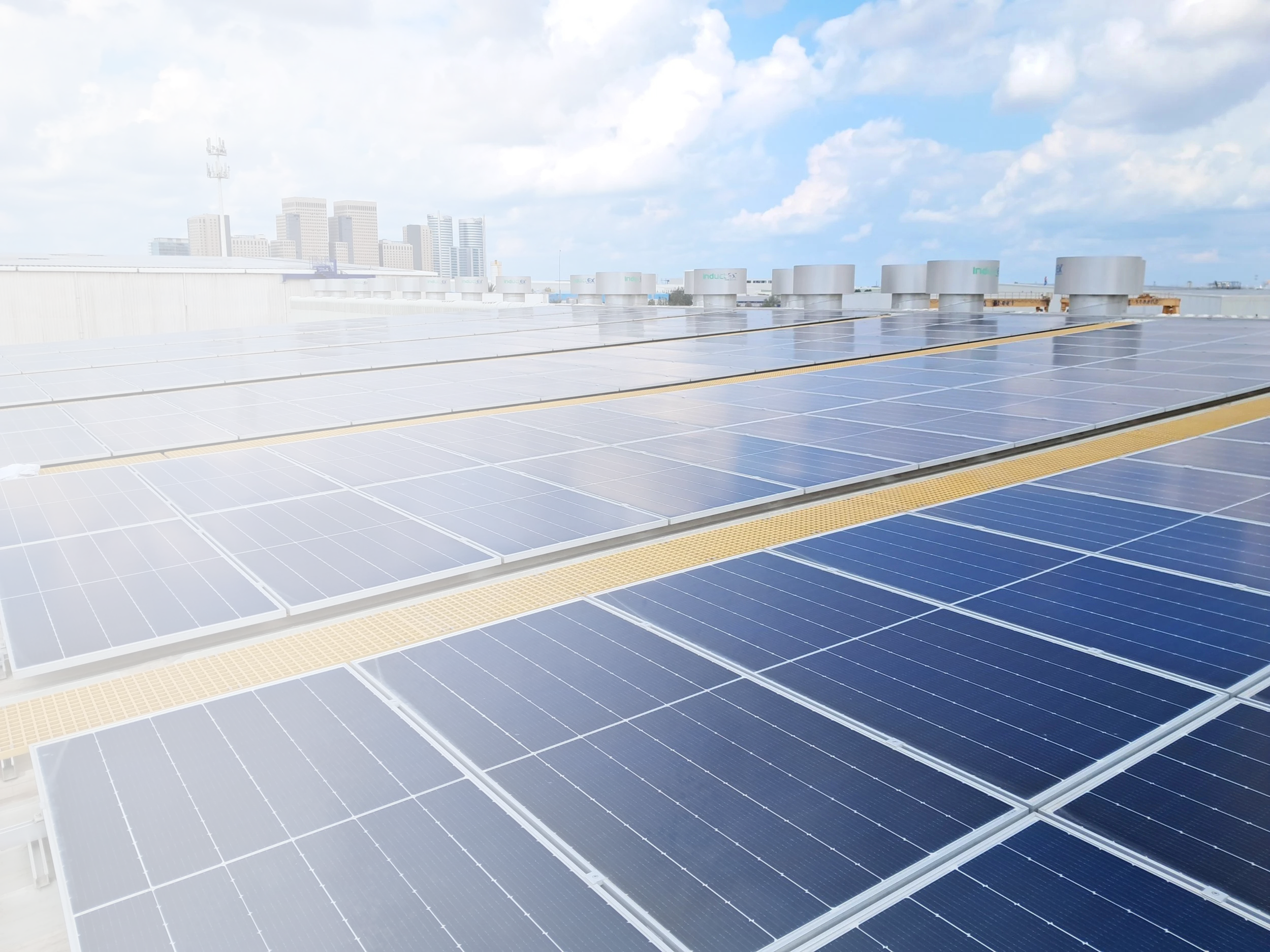
Work out what rooftop solar would save your building before you speak to anyone. Enter your roof area and your average monthly DEWA bill, and this calculator estimates your annual savings, your solar generation, and the CO₂ you would avoid under DEWA's Shams Dubai programme. It takes about thirty seconds and asks for no contact details.
Solar Calculator for the UAE
Discover Your Solar Savings - Estimate Your Savings & Impact
Quickly find out how much you can save with solar energy under DEWA's Shams Dubai Program! Our free solar potential calculator shows your expected cost savings, grid dependency, and environmental benefits like CO₂ reduction — all tailored to your property.
Solar Calculator
How the calculator works
The calculator asks for three things, and the third is the one that separates a realistic estimate from an optimistic one.
Available roof area (m²). The usable, unshaded roof area, not the building footprint. Subtract space taken by AC units, extract fans, skylights, walkways and any area shaded by a taller neighbouring structure. If you are unsure, use your building's gross roof area and treat the result as an upper bound.
Average monthly DEWA electricity expense (AED). Take a twelve-month average rather than a single bill. Summer consumption in most UAE facilities is substantially higher than winter, so a July bill will overstate your baseline and a January bill will understate it.
Total connected load of the plot (kW). Optional in the calculator, but the most important number if you want an estimate of how much solar you can actually install, based on DEWA's Shams Dubai regulation. It appears on your latest approved DEWA design approval, or can be found on your facility's as-built electrical load schedules or single line diagrams (SLDs). Contact us if you need help with this.
Why total connected load matters more than roof area
Most solar calculators size a system against roof area alone. In Dubai that produces a number that cannot be permitted.
Under the Shams Dubai connection conditions, installed solar capacity cannot exceed the applicable share of your plot's total connected load, and DEWA can impose a lower threshold where there are technical limitations in integrating the system into the local distribution grid. Your electrical infrastructure sets the ceiling, not your roof.
This matters commercially. A warehouse with a very large roof and a modest connected load will be quoted a large array by a calculator that ignores TCL, and then discover at application stage that the permittable system is considerably smaller. Entering your TCL here gives you the constrained figure from the start.
Annual savings with solar is the reduction in what you buy from DEWA. It is not income.
This distinction is worth being clear about, because it is frequently blurred. Under Shams Dubai, your building uses the electricity it generates first, and any surplus is exported to the grid through a bi-directional meter. DEWA credits that surplus against your future consumption.
Under Shams Dubai there is no feed-in tariff and no cheque. The financial case is a lower bill and a payback period, which is why the economic optimum is usually a system matched to what you actually consume rather than the largest array your roof can physically hold. An oversized system on a building with little evening or weekend load simply accumulates credits you may never use.
Annual solar generation (kWh) is a modelled figure based on typical UAE irradiance. Real output varies with panel orientation, tilt, shading and how often the array is cleaned.
Annual consumption (kWh) is derived from your monthly spend. If your tariff category differs from the assumed rate, this figure will shift.
What the results mean
What drives your payback period
Payback is the point at which accumulated bill savings equal what the system cost. Four things move it, and only two are within your control.
Self-consumption rate. The proportion of your generation you use on site rather than export. Because exported units become credits rather than cash, a building that consumes most of what it generates reaches payback sooner than one exporting heavily. This is why warehouses, factories and cold stores tend to perform well: the load profile matches the generation profile.
System size relative to consumption. Oversizing lengthens payback, because the additional capacity produces credits rather than savings. A system matched to your actual load almost always returns faster than the largest array the roof can hold.
Your tariff category. The higher the rate you currently pay per kWh, the more each unit of self-consumed solar is worth to you.
Maintenance. Dust soiling reduces output between cleans, so cleaning frequency affects lifetime generation and therefore the return.
Across the commercial systems we install under Shams Dubai, payback typically falls within four to seven years, after accounting for all costs including permitting fees and operations and maintenance expenses.
What this estimate does not include
An estimate is useful for deciding whether to have the conversation. It is not a proposal. Four things sit outside it:
Dust soiling. Panels in the UAE accumulate dust quickly and output falls measurably between cleans. Cleaning frequency belongs in the operating plan and the financial model, not discovered in year two.
The condition of your roof. A solar array has a service life measured in decades and is being mounted on a roof that may already be fifteen or twenty years into its own. Once panels and mounting rails are installed, large areas of roof become difficult and expensive to reach, so any waterproofing needed afterwards costs considerably more than it would have beforehand.
Structural capacity. Panels, rails and wind uplift on a large array create loads the original roof design may not have anticipated. This is checked against the building's structural drawings, not assumed.
Approvals. Grid-connected solar in Dubai must be designed and installed by a DEWA-enrolled solar PV contractor using equipment from DEWA's approved list, and the design is submitted for a No Objection Certificate before installation begins. Buildings in free zones typically need landlord consent or a zone work permit alongside the utility approvals.
Does your business qualify for D33 instead?
Most Dubai buildings connect rooftop solar under Shams Dubai, which is what this calculator models. There is a second route, and if you qualify for it the numbers above do not apply to you.
DEWA's D33 policy is open to businesses in three industrial categories: manufacturing, data centres and agri-tech. It is not an alternative you can simply opt into. It requires a D33 certificate, and eligibility is determined by your activity.
Where it differs from Shams Dubai:
Capacity. D33 allows solar capacity far beyond the Shams Dubai share of connected load, up to the full total connected load of the plot. For a manufacturing facility with a large roof, that is a materially bigger system.
How exported power is valued. Shams Dubai credits your exports against future consumption. D33 works on a feed-in tariff basis, where DEWA purchases the excess rather than crediting it, on a seasonal basis.
Ground-mounted systems. Excluded under Shams Dubai, permitted under D33. Relevant if you have yard space alongside roof area.
Because the capacity ceiling, the export model and the permitted mounting types are all different, a Shams Dubai calculator will understate what a D33 facility can install and misprice what it earns. If you are in one of the three categories, contact us and we will model it properly.
Our blog post on DEWA's D33 policy covers the background in more detail.
If the numbers look worth pursuing, the next step is a site survey rather than a quotation. We look at the roof's condition, your electrical infrastructure, your actual consumption profile and your connected load, and design a system against all four.
Solaroofing has been waterproofing metal roofs in the UAE for over 30 years and designing and installing solar PV since 2019. Because we handle both, the array is designed onto a roof we have surveyed and made completely watertight. On top of the fully sealed roof, every mounting penetration is also sealed as part of our roofing scope, rather than negotiated between two contractors after a leak appears.
We handle the approvals process end to end, including DEWA, DM, DDA, DIP, JAFZA, Trakhees and DCD.
Our clients include the UAE Ministry of Defence, Dubai Police, Dubai Civil Aviation Authority and Drydocks World, alongside factories and warehouses across Jebel Ali, Dubai Investments Park, National Industries Park, Dubai Industrial City, Al Quoz Industrial Area, Musaffah, ICAD and numerous other industrial areas within the UAE.
From estimate to proposal
Frequently Asked Questions
-
It depends on your consumption, your roof area and your connected load, which is what the calculator above estimates. The saving comes from buying less electricity from DEWA rather than from selling power, so the figure that matters is how much of your own generation you consume on site. Facilities with a strong daytime load, such as warehouses and factories running lighting, ventilation and chillers through the working day, tend to self-consume the highest proportion and see the shortest payback.
-
It is an estimate for deciding whether the project is worth exploring, not a proposal. It models typical UAE irradiance and derives your consumption from your monthly spend, so actual output varies with orientation, tilt, shading, dust soiling and cleaning frequency. A site survey of the roof, the electrical infrastructure and twelve months of consumption data produces the figure you would budget from.
-
No. This calculator models DEWA's Shams Dubai programme. Businesses in manufacturing, data centres and agri-tech may qualify for DEWA's D33 policy instead, which allows a much larger system relative to connected load, values exported power on a feed-in tariff basis rather than as bill credits, and permits ground-mounted systems. If you are in one of those three categories, contact us and we will model your D33 savings directly rather than relying on this tool.
-
Under Shams Dubai, no. The surplus your building exports is credited against future consumption rather than paid out, so the business case rests on bill reduction and systems should be sized against actual consumption rather than available roof area. Businesses qualifying for DEWA's D33 policy are treated differently, with exported power purchased on a feed-in tariff basis rather than credited.
-
Capacity is limited by your plot's total connected load rather than by your roof area, under the thresholds set out in the Shams Dubai connection conditions, and DEWA can apply a lower limit where local grid conditions require it. This is why the calculator asks for your total connected load, and why it should be established at feasibility stage before any design is priced.
-
Physical fit is determined by usable unshaded area after deducting AC units, extract fans, skylights, walkways and shaded zones, but physical fit rarely sets the system size. The connected load ceiling and your consumption profile usually produce a smaller and more economical system than the roof could hold.
-
If the roof needs work, yes, and by a clear margin. Once panels and mounting rails are in place, access to large sections of roof becomes difficult and costly, so waterproofing carried out afterwards is significantly more expensive. A roof condition survey before the solar design is fixed is the cheapest step in the whole project.
-
It varies with your tariff category, your self-consumption rate and the system size relative to your actual load. The single biggest factor is how much of your generation you use on site rather than export, because exported units become bill credits rather than cash. Facilities with a strong daytime load, such as warehouses and factories, typically reach payback within four to seven years, after accounting for all costs including permitting fees and operations and maintenance expenses. A site survey with twelve months of consumption data produces a figure you can budget against.