
Warehouse Roof Waterproofing in Dubai: What Facilities Managers Need to Know
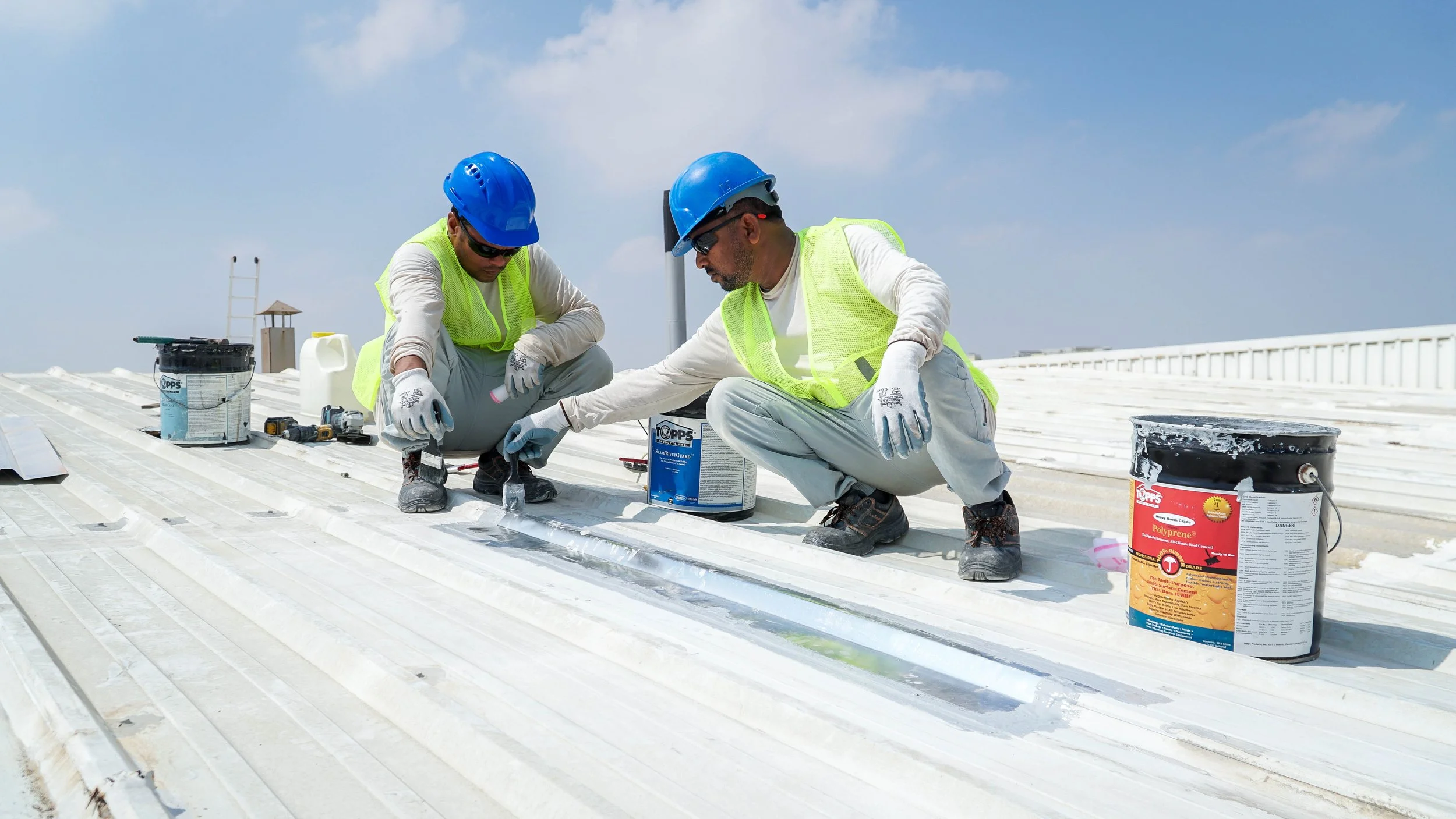
The roof is rarely the expensive part.
When water gets into a warehouse in Dubai, the repair bill for the roof itself is usually the smallest number on the page. The larger costs sit underneath it: stock written off, a damaged racking run, a control panel that shorted, an insurance excess, and the hours spent moving pallets away from a drip while someone finds a contractor.
That gap between the cost of the roof and the cost of what is under it is the entire argument for treating a warehouse roof as a planned asset rather than a reactive one. Below is how these roofs fail in this climate, what a proper waterproofing job actually involves, and what a condition survey should tell you before you commit to any work.
Why warehouse roofs are a different problem
A villa roof and a warehouse roof fail for different reasons, and they need different answers.
The spans are long. Warehouse roof sheets often run twenty metres or more without a break. Metal expands and contracts with heat, and the longer the run, the more total movement there is at every joint, lap and fastener. A roof in Jebel Ali goes through that cycle every single day, with surface temperatures climbing far above ambient in summer before dropping sharply overnight. Over a few years that movement works sealant loose, backs fasteners out, and opens sidelaps that were watertight on handover.
The roof is full of holes that were not in the original drawings. Every AC unit, extract fan, cable entry and pipe stack is a penetration through the roof plane. Retrofit penetrations are almost always the weakest points on a warehouse roof, because they were cut in after the building was finished, often by a trade whose job was the equipment rather than the roof.
Nobody goes up there. A warehouse roof is out of sight. Unlike a leaking office ceiling, the early signs (rust streaking, cracked sealant, a gutter half full of sand) are invisible from the floor. Problems are usually discovered at the point where they have already become expensive.
You cannot stop production to fix it. Any solution has to work around a live operation, which rules out approaches that require access from inside or extended shutdowns.
How these roofs actually fail in the UAE
Across three decades working on metal roofs in this region, the same short list accounts for most of what we find.
Sidelaps and endlaps. Where two sheets overlap, ageing sealant plus daily thermal movement eventually opens the joint, and capillary action draws water uphill into the lap. This is the single most common entry point on long-span warehouse roofs.
Fasteners. Screws gradually back out under thermal cycling and their washers harden and split under UV. A roof carrying several thousand fasteners does not need many failures before leaks become a recurring event.
Gutters and drainage. This is the failure mode that catches people out here. Sand accumulates in gutters far faster than in most climates, and a warehouse roof discharges an enormous volume of water in a short time during a heavy rain event. A partially blocked gutter backs water up above the level of the sheet ends, and it flows directly into the building. The roof itself may be sound.
Skylights. Roof lights go brittle under years of UV exposure and crack around their fixings, while the perimeter flashing sits at a junction between two materials that expand at different rates.
Parapets and wall abutments. Flashing and counter-flashing at these junctions absorb a lot of movement, and failed sealant here produces water that appears along the building's edges.
Leak or condensation? Establish this first
Before quoting any waterproofing work, it is worth confirming what you are actually dealing with, because getting this wrong wastes a great deal of money.
A cool interior beneath a hot, humid exterior creates ideal conditions for condensation on the underside of the roof deck. Cold stores, chilled warehouses and heavily air-conditioned production halls all produce it. It looks exactly like a leak: dripping water, damp insulation, corrosion on the steelwork.
The distinction is usually clear once you know the signs. Condensation appears in still, humid conditions rather than during rain, it spreads evenly across a broad area instead of concentrating at one point, and it tends to be worst in the early morning. If that describes your problem, the answer lies in ventilation and insulation, and no amount of sealant on the roof will change it.
What a proper warehouse waterproofing job involves
Applying a coating over a roof that has not been prepared is the reason so many waterproofing jobs fail within a couple of years. The sequence matters.
1. Roof condition survey. The full roof is inspected, not just the area above the leak, and the condition of every element is documented: sidelaps, endlaps, fasteners, flashings, skylights, penetrations, gutters and outlets. Internal staining patterns are mapped against the roof plan, because water frequently travels along a purlin and drops several metres from where it entered.
2. Restoration. Old sealant is removed, the sheets are deep cleaned, corroded areas are treated, and weakened sections are reinforced with new metal bent to match the existing profile. This is the step that determines whether the waterproofing lasts.
3. Waterproofing. Elastomeric sealants and coatings are applied to every critical area of the roof. The reason elastomeric systems suit this climate is that they stretch and move with the roof's daily thermal cycle rather than cracking against it, which is precisely what rigid products fail to do here.
4. Handover and warranty. A written guarantee, with the term depending on the system applied.
All works are carried out from the roof exterior. Operations continue underneath, with scheduling agreed around your shifts.
Warehouses with solar, or planning it
If rooftop solar is installed or planned, sequence matters more than most people expect. Once panels and mounting rails are in place, large areas of roof become difficult and expensive to access, and any waterproofing work afterwards costs considerably more than it would have beforehand.
Waterproofing first protects the roof for the full service life of the solar array, and the penetrations for the mounting system get sealed as part of the works rather than as an afterthought by the solar installer. We cover this in more detail in our guide to waterproofing before solar installation.
Planning around a live operation
A few practical points that come up on nearly every warehouse project.
Access and permits. Buildings in JAFZA, Dubai Investments Park and similar zones frequently need landlord approval or a free zone work permit before roof works begin. Factor that into the timeline rather than discovering it on day one.
Timing. The sensible window is before the rain season, not during it. Restoration works need dry conditions, and the queue for contractors lengthens considerably once the first heavy rain has arrived.
Inspection rhythm. Twice a year is a reasonable baseline for most facilities, ideally before and after the rain season, plus a check after any major storm. Roofs carrying solar arrays, plant equipment or regular foot traffic warrant more frequent attention.
Where to start
If you have an active leak, the priority is finding the actual entry point rather than sealing the spot above the drip. Our guide to [industrial roof leak detection] explains how that is done.
If you do not have a leak yet, a roof condition survey is the cheaper conversation. It tells you what is failing now, what will fail next, and the scope of work the roof actually needs, before the answer is decided for you by a wet pallet in aisle four.
Solaroofing has worked on metal roofs across Dubai and the UAE since 1994, for clients including the UAE Ministry of Defence, Dubai Police, Dubai Civil Aviation Authority and Drydocks World, alongside factories and warehouses throughout Jebel Ali and Dubai's industrial areas. Surveys are free and carry no obligation, and the report is yours to keep either way.
Frequently Asked Questions
How much does warehouse roof waterproofing cost in Dubai? Every roof is priced from a survey rather than a rate card, because cost depends on the roof area, the condition of the sheets and sealants, the extent of restoration required and the warranty term selected. A roof needing only sealing costs considerably less than one requiring sheet replacement and corrosion treatment first. The survey and quotation are free.
Do we need to stop warehouse operations during the work? No. All works are carried out from the roof exterior, so production, storage and loading continue as normal underneath. Scheduling is agreed in advance with your facilities team, and works around your shift patterns.
How long does warehouse roof waterproofing last? Warranties typically run from five years for sealing of critical areas up to 10+ years for full restoration with a reflective elastomeric coating. With periodic maintenance, a good waterproofing system performs beyond its warranty period. Plus, the warranty periods are always extendable. We've been taking care of some roofs in Dubai for 30 years.
What does a roof condition survey include? A full inspection of the entire roof area rather than just the problem zone: the condition of sidelaps and endlaps, fasteners, flashings and skylights, the state of any existing coating, corrosion locations and severity, drainage capacity and blockages, and internal staining mapped against the roof plan. The output should tell you what is failing now, what will fail next, and the scope of restoration the roof requires.
When is the best time of year to waterproof a warehouse roof in the UAE? Ahead of the rain season rather than during it. Restoration works require dry conditions for proper surface preparation and curing, and contractor availability tightens significantly once the first heavy rain has fallen.
Can you waterproof a warehouse roof that already has solar panels? Yes, though it is more involved and more expensive than doing it beforehand, because panels and mounting rails restrict access to large areas of the roof. If solar is planned but not yet installed, waterproofing first is the more economical sequence by a clear margin.
